

By The Panelmart Engineering Team | Fact-Checked & Updated: April 2026
What Does Texas TFER Require for Floor-to-Wall Junctures in Food Facilities?
Building a commercial kitchen or meat processing plant in Texas means navigating some of the strictest health codes in the United States. When the state inspector arrives, one of the very first things they check is the bottom of your walls.
If you have installed fiberglass reinforced plastic panels, you need the right FRP wall panel trim to connect them to the floor. Choosing a cheap peel and stick base is a guaranteed way to fail your inspection. Therefore, to pass, you must thoroughly understand the Texas Food Establishment Rules and build an architectural barrier that can survive rigorous sanitation routines.
What Does TFER §228.173 Require for Floor Junctures?
The state code is very clear about how commercial floors and walls must interact. According to the official Texas Department of State Health Services (DSHS), TFER §228.173 specifically dictates the construction of physical facilities.
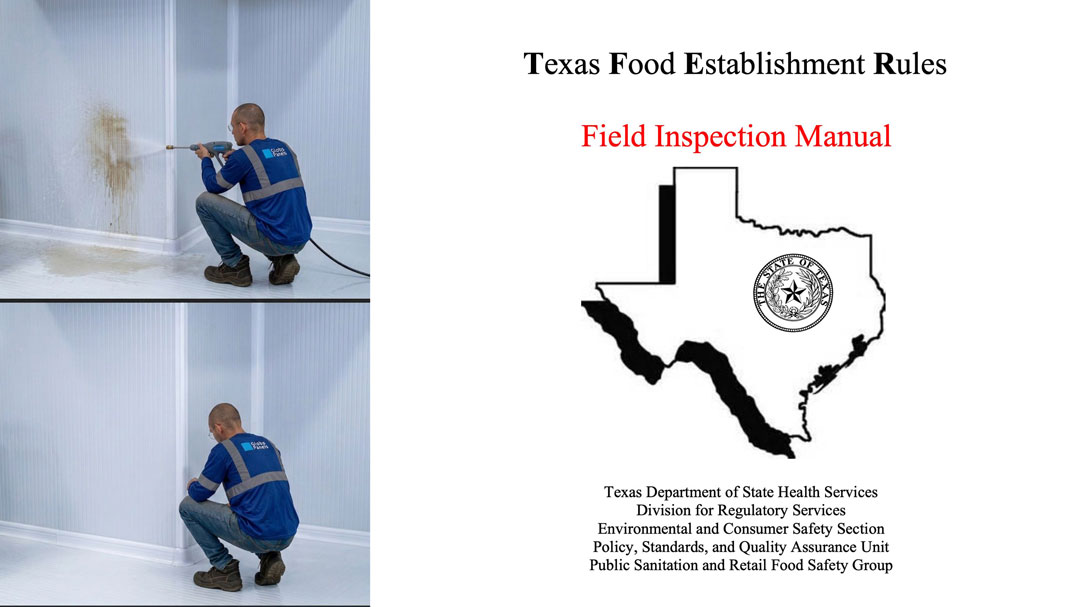
While standard rooms require a tightly closed juncture — see our guide on the Texas 1mm gap rule — the rules change drastically if your facility uses water flush cleaning methods. Specifically, if your crew uses hoses, power washers, or heavy buckets of water to clean the floors, TFER mandates that the floors must drain properly. In addition, all wall junctures must be meticulously coved and completely sealed against moisture.
Why Do Glued Baseboards Fail Water Flush Inspections?
The term “water flush” is the enemy of traditional construction adhesives. When a contractor glues a roll of rubber or vinyl baseboard to the bottom of a wall, that adhesive is immediately subjected to brutal conditions.
Daily exposure to standard hot water washdowns, degreasers, and acidic chemical foamers quickly softens the glue behind the rubber. As a result, within a few months, the rubber peels away from the wall. This broken seal allows dirty water to pool behind the baseboard, rotting the drywall and creating a breeding ground for Listeria. Consequently, when the inspector sees a peeling baseboard, they will immediately issue a citation for failing to maintain a sealed juncture.
How Does Rigid PVC Sanitary Cove Base Solve the Texas Compliance Problem?
To survive a Texas water flush environment, you need an architectural finish that relies on mechanical engineering rather than glues. This is exactly why Panelmart provides the CoRound sanitary cove base system. Our rigid PVC sanitary cove base acts as a permanent, waterproof boot for the bottom of your walls. For full commercial kitchen specifications, see our dedicated guide on commercial kitchen baseboards.
- Mechanical fastening: The CoRound system is screwed directly into the wall structure. There are no adhesives to soften. Therefore, the profile will never peel away during high-pressure water flushing.
- Silicone-free hermetic seal: The rigid body features flexible, co-extruded rubberized lips. When fastened, these lips compress tightly against your FRP panels and the floor. As a result, they create a completely watertight seal that blocks moisture from reaching the drywall.
- Inspection-ready geometry: The CoRound system features a sweeping curve that exceeds the mandated 3/8-inch minimum radius requirement. Consequently, it ensures effortless cleaning and guaranteed health department compliance.
Build for Texas Standards
In summary, do not let a cheap, peeling baseboard delay your grand opening. By specifying Panelmart’s CoRound system, you are equipping your facility with the material engineered specifically to meet TFER regulations. Contact Panelmart today to secure your rigid PVC sanitary cove base and pass your next Texas health inspection with confidence.