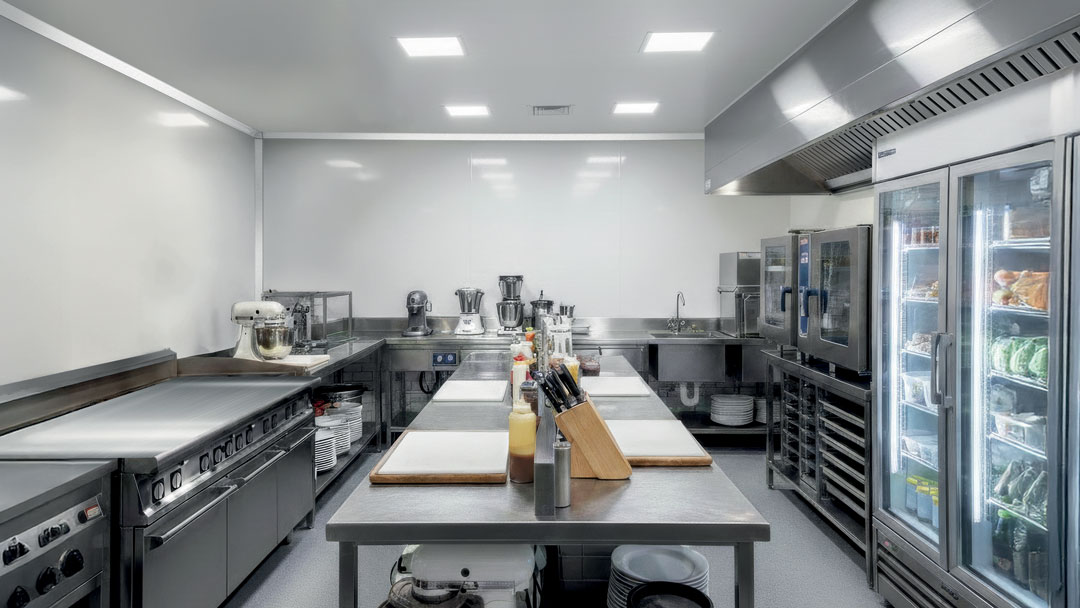


The rounded profile removes the square corner where dirt builds up, and the smooth, non-porous surface is easy to clean. That is the job of a commercial kitchen cove base, from the cook line to the dish area. With the CoRound™ system, three things change on the job site. No sealant line required along the wall. Pre-formed corners, no silicone-filled field cuts. No resin or cement to cure. Searching for commercial kitchen baseboards? Ask for a sanitary cove base.
By Panelmart · Updated: October 2026
Why Does a Commercial Kitchen Need a Rounded Wall-Floor Juncture?
Square corners can trap dirt and water, and that is where bacteria can grow. A rounded profile leaves fewer of those spots and makes them easier to wash out.
FDA Food Code §6-201.13 requires floor and wall junctures to be coved and closed to no larger than 1 mm (1/32 inch) where floors are not cleaned by water flushing, and coved and sealed where they are. Check requirements with your local health department.
That is why the material matters, too. Resistant to common cleaning chemicals; can be washed with water up to +140 °F.
Then read our guide to coved floor and wall junctures.
Why Choose a Rigid PVC Cove Base Instead of Rubber?
The CoR Skirt is a rigid PVC cove base for the wall-floor juncture. Unlike a rubber base, it can be screwed or riveted to the wall, so it doesn’t have to depend on adhesive.
When the CoR Skirt is screwed or riveted, the fasteners sit behind a snap-on cover strip: no exposed screw heads to collect dirt.
So, for the full picture, read our rubber cove base comparison.
Why Choose Rigid PVC Instead of Tile or Stainless Steel?
A tile cove base has grout lines, and grout can hold dirt and moisture. CoRound profiles have a smooth PVC surface with no grout lines. See our quarry tile comparison, too.
A stainless steel base can dent and rust, and the exposed silicone along it can blacken and come loose. CoRound replaces it with no welding on site, and it costs less than stainless steel. More in our stainless steel trim comparison.
The CoRound Basic line also comes in Stainless Steel Gray 9023, for rooms with stainless steel or Galvalume® walls and equipment. However, the gray is similar to stainless steel and Galvalume®, not an exact match: ask for a free sample to check it against your walls. See the CoRound Basic System.
Can a Commercial Kitchen Cove Base Go In While the Kitchen Is in Operation?
In a room already in operation, CoRound can be installed on the finished floor: there is no floor to redo and nothing to cure.
Installing CoRound is one pass along the wall: fasten the profile and snap in the corners.
In addition, columns take pre-formed outside corners, and each run stops at an end cap at the door: no miter cuts to fill with silicone.
How Do You Protect Wall Corners in a Busy Kitchen?
For outside corners, the CoR Protector is a corner guard that protects wall corners against everyday bumps from carts and mop buckets. Also, the color runs through the PVC: a hit or a scratch shows the same color, and there is no paint or coating to chip.
One system for the whole room: base track, sanitary base or heavy-duty curb, cove base for wall and ceiling junctions, pre-formed corners, end caps and corner guards, all made to fit together.
What Should You Check Before You Order a Commercial Kitchen Cove Base?
First, measure each wall where the cove base runs. Then count the inside corners, the outside corners and the door openings. Next, note the wall type: insulated panels, FRP, tile, masonry or drywall.
Finally, pick the color. The CoR Skirt S comes in Pure White 9010 and Sand White 9002. The CoR Skirt B also comes in Stainless Steel Gray 9023. With those numbers, you can list the profiles and pieces, and we send you a quote.
Why Choose a Commercial Kitchen Cove Base From Panelmart?
- No sealant line required along the wall: one less step on site and, as a result, one less cost that can recur.
- Pre-formed corners, no silicone-filled field cuts: the curve comes from the factory, not from the installer’s hand.
- No resin or cement to cure: the crew fastens the profile and snaps in the corners.
- Repairs by the length: a damaged length can be replaced on its own: the rest of the run stays in place.
The CoRound system — stocked in the US by Panelmart. Available by the box or by the piece. Browse the full range of sanitary PVC profiles, including the cove base for commercial kitchens.
Frequently Asked Questions
Can a rigid PVC cove base go on tile or drywall?
Yes. Installs on insulated panels, FRP-covered walls, tile, masonry and drywall. So, if in doubt, ask for a free sample to check it on your wall.
Do you need silicone when you install a rigid PVC cove base?
Silicone is optional: not required for installation. For the CoR Skirt, in wet areas, installers can add a thin bead of neutral silicone to help keep water from getting behind the profile.
Can I see the profiles before I order?
Yes. Free samples are available on request: email [email protected] and list the profiles you need.
How Do I Get a Quote, Specs or Free Samples?
Call or message us at +1 786 917 8106 (phone and WhatsApp), or email [email protected]. Our technical team usually responds within one business day. Contact Panelmart today for a quote, specs or free samples.
Galvalume® is a registered trademark of BIEC International, Inc.