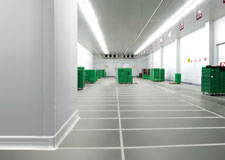


The rounded profile removes the square corner where dirt builds up, and the smooth, non-porous surface is easy to clean. In a cleanroom, that matters at the floor, in the wall corners and at the ceiling. This guide looks at the cleanroom cove base in those three places. With the CoRound™ system, three things change on the job site. No sealant line required along the wall. Pre-formed corners, no silicone-filled field cuts. No resin or cement to cure.
By Panelmart · Updated: October 2026
Why Do the Corners of a Cleanroom Matter?
Square corners can trap dirt and water, and that is where bacteria can grow. A rounded profile leaves fewer of those spots and makes them easier to wash out.
For this reason, CoRound also has profiles for the wall corners and the ceiling.
For the basics, first read what a PVC sanitary cove base is.
How Does CoRound Cover the Floor, the Wall Corners and the Ceiling?
In general, cleanroom coving covers more than the floor. To begin with, at the floor, the CoR Skirt sanitary base covers the wall-floor juncture. Flexible co-extruded lips press against the wall and the floor and follow small surface irregularities, closing the juncture.
Similarly, the CoR 4 cove base covers the wall-to-wall junction and the wall-to-ceiling junction. Flexible co-extruded lips press against both walls, or the wall and the ceiling, and follow small surface irregularities, closing the junction. The CoR Skirt and the CoR 4 have a radius that exceeds 3/8 inch.
At the ceiling, for example, the job takes two steps. Fasten the CoR 4 Base profile to the ceiling with screws or rivets, then snap the CoR 4 onto it.
What Does “No Sealant Line Required Along the Wall” Mean?
Exposed sealant can need cleaning and, over time, redoing: each time that means a service call, material and labor. With CoRound, no sealant line is required along the wall.
On standard cold storage panels with mesa or wide-rib profiles, the flexible lip follows the ribs. As a result, the flexible lip minimizes gaps along the wall, with no sealant line required.
In other words, there is one less line to keep clean along the base of each wall.
How Do Pre-Formed Corners Help?
For example, with a metal base, each corner, column and door opening can mean a miter cut on site and silicone to close it, and the result depends on the installer’s hand. CoRound has pre-formed pieces for them: joints, 90° inside and outside corners, and end caps.
In contrast, the curve comes from the factory, not from the installer’s hand: it is the same all the way around the room.
Seal Cap: A cap that covers the fastener holes on the Seal components, so the holes are not left open to collect dirt. Included with the Seal components; also available separately.
Why Choose a Rigid PVC Cove Base Instead of a Troweled Resin Cove?
First, a troweled cove is bonded to both the wall and the floor. Where the wall is an insulated metal panel, wall and floor move at different rates, and the cove can crack or pull away at the top. CoRound is fastened to the wall, and its flexible lip rests on the floor.
Besides, with a resin or tile cove, a repair can mean cutting out a section, redoing it and waiting for it to cure. With CoRound, however, a damaged length can be replaced on its own: the rest of the run stays in place.
See our resin coving comparison for more.
What Goes Into a CoRound Profile?
To begin with, the CoR Skirt and the CoR 4 have a rigid PVC body with flexible co-extruded lips.
The raw materials do not contain lead, mercury, cadmium, hexavalent chromium, PBB, PBDE, DEHP, BBP, DBP or DIBP. Also, a written declaration on the material composition is available on request.
In addition, the color runs through the PVC: a hit or a scratch shows the same color, and there is no paint or coating to chip.
Which Rooms Use CoRound?
Designed for walk-in coolers, food plants and commercial kitchens. Applications also include cleanrooms and pharmaceutical facilities. Installs on insulated panels, FRP-covered walls, tile, masonry and drywall.
In rooms built with insulated panels, for example, the CoR Channel works as the base track. The CoR Skirt snaps into it.
In addition, for other rooms, read our guides on the cove base for walk-in coolers and the food processing cove base.
Why Choose CoRound From Panelmart?
- No sealant line required along the wall: one less step on site and, as a result, one less cost that can recur.
- Pre-formed corners, no silicone-filled field cuts: the curve comes from the factory, not from the installer’s hand.
- No resin or cement to cure: there is nothing to mix, trowel, weld or cure.
- One system for the whole room: base track, sanitary base or heavy-duty curb, cove base for wall and ceiling junctions, pre-formed corners, end caps and corner guards, all made to fit together.
The CoRound system — stocked in the US by Panelmart. Available by the box or by the piece. Browse the CoRound Seal System or all sanitary PVC profiles.
Not sure which pieces your room needs? Then ask our technical team.
Frequently Asked Questions
Do you need silicone to install CoRound?
Silicone is optional: not required for installation. For the CoR Skirt, in wet areas, installers can add a thin bead of neutral silicone to help keep water from getting behind the profile.
Can a PVC cove base handle cleaning chemicals?
CoRound profiles are resistant to common cleaning chemicals and can be washed with water up to +140 °F.
Where can I buy CoRound profiles?
Panelmart stocks the CoRound system in the US. Delivery is nationwide, and free samples are available on request.
How Do I Get a Quote, Specs or Free Samples?
Call or message us at +1 786 917 8106 (phone and WhatsApp), or email [email protected]. Our technical team usually responds within one business day. Contact Panelmart today for a quote, specs or free samples.