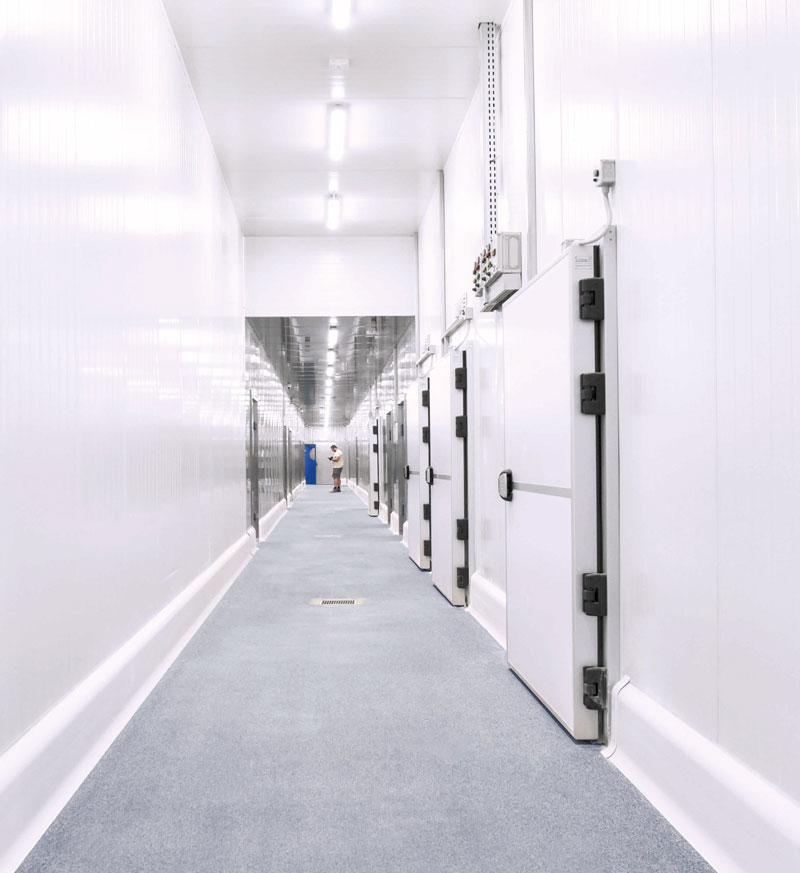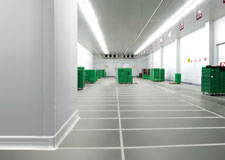


The rounded profile removes the square corner where dirt builds up, and the smooth, non-porous surface is easy to clean. That matters in a food plant, because crews wash down walls and floors often. With a food processing cove base from the CoRound™ system, three things change on the job site. No sealant line required along the wall. Pre-formed corners, no silicone-filled field cuts. No resin or cement to cure.
By Panelmart · Updated: October 2026
Why Do Square Corners Matter in a Food Plant?
That is because square corners can trap dirt and water, and that is where bacteria can grow. A rounded profile leaves fewer of those spots and makes them easier to wash out.
In FDA’s HACCP Principles & Application Guidelines, facilities are listed among the prerequisite programs: ‘The establishment should be located, constructed and maintained according to sanitary design principles.’ Check requirements with your local health department.
For the basics of a food plant cove base, first read what a PVC sanitary cove base is.
What Happens to the Cove Base When Crews Wash Down the Room?
First, at the floor, the CoR Skirt sanitary base covers the wall-floor juncture. Flexible co-extruded lips press against the wall and the floor and follow small surface irregularities, closing the juncture. The flexible lip minimizes gaps along the wall, with no sealant line required. Also, in wet areas, installers can add a thin bead of neutral silicone to help keep water from getting behind the profile.
Similarly, between walls and at the ceiling, the CoR 4 rigid PVC cove base snaps onto the CoR 4 Base. Flexible co-extruded lips press against both walls, or the wall and the ceiling, and follow small surface irregularities, closing the junction.
In addition, metal bases and channels can rust where water sits. PVC does not rust.
Where Does a Food Processing Cove Base Go?
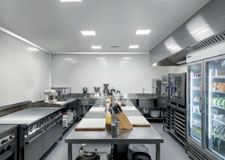
Designed for walk-in coolers, food plants and commercial kitchens. Installs on insulated panels, FRP-covered walls, tile, masonry and drywall.
For example, use the CoR Skirt along the walls of processing and packing rooms, and the CoR 4 in the wall corners and at the ceiling. In addition, under the panels, the CoR Channel works as the base track, and the CoR Skirt snaps into it.
Why Choose a Rigid PVC Cove Base Instead of Resin?
To begin with, a troweled cove is bonded to both the wall and the floor. Where the wall is an insulated metal panel, wall and floor move at different rates, and the cove can crack or pull away at the top. CoRound is fastened to the wall, and its flexible lip rests on the floor.
In addition, a resin cove is usually part of the floor job: the room is cleared and waits for the resin to cure. CoRound is a wall job: it installs on the finished floor, and the room can stay in use.
For more, also see our resin coving comparison and our guide to epoxy curing time.
What Happens When Forklifts Operate Near the Walls?
The CoR Curb is a heavy-duty PVC curb for the base of the wall. Protects the wall from forklift impacts. It protects the wall, not people: it is not a safety barrier. In particular, where forklifts operate, the CoR Curb takes the place of the sanitary base at the wall-floor juncture.
Also, a rigid curb, poured or precast, can chip or crack under a hard forklift hit. The CoR Curb is resilient PVC that flexes on impact. In addition, the CoR Curb installs on a finished wall and floor: no formwork, no pouring, no concrete to cure.
How Do You Install a Food Processing Cove Base?
Installing CoRound is one pass along the wall: fasten the profile and snap in the corners. On a panel job, for example, the sequence looks like this. First, set the base track and the panels.
Then fasten the CoR 4 Base supports and snap the CoR 4 onto them. Next, fasten the CoR Skirt to the base of the wall. Finally, press or snap the corner pieces, joints and end caps into place.
Why Choose a Food Processing Cove Base From Panelmart?
- No sealant line required along the wall: one less step on site and, as a result, one less cost that can recur.
- Pre-formed corners, no silicone-filled field cuts: the curve comes from the factory, not from the installer’s hand.
- No resin or cement to cure: there is nothing to mix, trowel, weld or cure.
- One system for the whole room: base track, sanitary base or heavy-duty curb, cove base for wall and ceiling junctions, pre-formed corners, end caps and corner guards, all made to fit together.
The CoRound system — stocked in the US by Panelmart. Delivery is nationwide. Available by the box or by the piece. Then browse the CoRound Seal System or all sanitary PVC profiles, from the washdown cove base to the corner guards.
Walk-in coolers in the plant? Read our cold storage cove base guide, too. The same profiles serve as the cove base for food plants and for walk-in coolers.
Frequently Asked Questions
Can a PVC cove base handle cleaning chemicals?
Resistant to common cleaning chemicals; can be washed with water up to +140 °F. Also, ask for a free sample to try it with your cleaning products.
Do you need silicone when you install a cove base in wet areas?
Silicone is optional: not required for installation. For the CoR Skirt, in wet areas, installers can add a thin bead of neutral silicone to help keep water from getting behind the profile.
Does Panelmart sell corner guards for food plants?
The CoR Protector is a corner guard that protects wall corners against everyday bumps from carts and mop buckets. The color runs through the PVC: a hit or a scratch shows the same color, and there is no paint or coating to chip.
How Do I Get a Quote, Specs or Free Samples?
Call or message us at +1 786 917 8106 (phone and WhatsApp), or email [email protected]. Our technical team usually responds within one business day. Contact Panelmart today for a quote, specs or free samples.