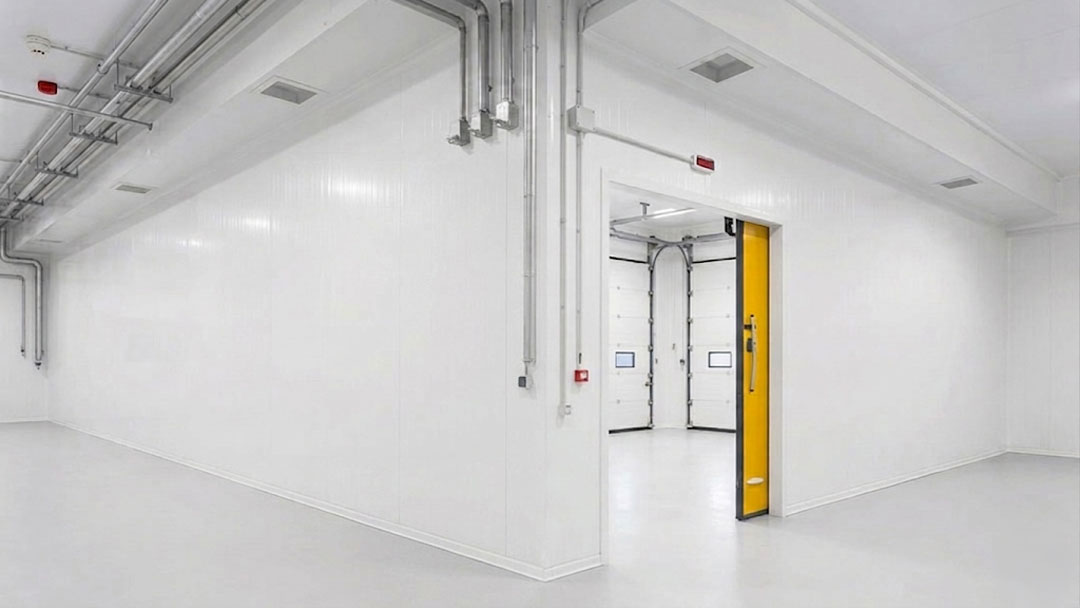


The rounded profile removes the square corner where dirt builds up, and the smooth, non-porous surface is easy to clean. That is the job of a PVC sanitary cove base. With the CoRound™ system, three things change on the job site. No sealant line required along the wall. Pre-formed corners, no silicone-filled field cuts. No resin or cement to cure. This guide explains what the profile is, where it goes and how it installs.
By Panelmart · Updated: October 2026
What Material Goes Into a PVC Sanitary Cove Base?
CoRound profiles are precision-extruded from rigid PVC, with flexible co-extruded lips on the cove base and the sanitary base. The PVC is lead-free; the rigid body is calcium-zinc stabilized. As a result, a rigid PVC cove base comes from the factory as a finished profile.
The raw materials do not contain lead, mercury, cadmium, hexavalent chromium, PBB, PBDE, DEHP, BBP, DBP or DIBP. Also, a written declaration on the material composition is available on request.
In addition, the color runs through the PVC: a hit or a scratch shows the same color, and there is no paint or coating to chip.
Why Does a Square Corner Matter?
That is because square corners can trap dirt and water, and that is where bacteria can grow. A rounded profile leaves fewer of those spots and makes them easier to wash out.
FDA Food Code §6-201.13 requires floor and wall junctures to be coved and closed to no larger than 1 mm (1/32 inch) where floors are not cleaned by water flushing, and coved and sealed where they are. Check requirements with your local health department.
Where Does a PVC Sanitary Cove Base Go?
CoRound is a system of rigid PVC profiles that rounds off the corners of a room: where the wall meets the floor, where two walls meet, and where the wall meets the ceiling.
- Wall-floor juncture: the CoR Skirt S or CoR Skirt B sanitary base. Flexible co-extruded lips press against the wall and the floor and follow small surface irregularities, closing the juncture.
- Wall-to-wall and wall-to-ceiling junctions: the CoR 4 cove base, which snaps onto the CoR 4 Base.
- Base of the panels: the CoR Channel, a PVC base track that the CoR Skirt snaps into.
- Outside wall corners: the CoR Protector, a corner guard that protects wall corners against everyday bumps from carts and mop buckets.
The CoR Skirt and the CoR 4 have a radius that exceeds 3/8 inch. Moreover, in a washdown, water runs from the ceiling down the walls to the floor. With CoRound profiles at the ceiling, in the wall corners and at the floor, it meets a curve, not a square corner, at each junction.
Designed for walk-in coolers, food plants and commercial kitchens. Installs on insulated panels, FRP-covered walls, tile, masonry and drywall. Applications also include cleanrooms and pharmaceutical facilities.
Then, for details by room, read our guides on the cove base for cold storage, on commercial kitchens and on food processing plants.
Why Choose a PVC Cove Base Instead of Rubber, Tile or Metal?
A flat wall base covers the bottom of the wall, but it leaves a square corner at the floor. In contrast, a PVC sanitary cove base replaces that corner with a curve.
The CoR Skirt is a rigid PVC sanitary base. Unlike a rubber base, it can be screwed or riveted to the wall, so it doesn’t have to depend on adhesive. More in our rubber cove base comparison.
A tile cove base has grout lines, and grout can hold dirt and moisture. CoRound profiles have a smooth PVC surface with no grout lines.
With a resin or tile cove, a repair can mean cutting out a section, redoing it and waiting for it to cure. However, a damaged length can be replaced on its own: the rest of the run stays in place.
Also, metal bases and channels can rust where water sits. PVC does not rust.
What Are the Advantages of a PVC Sanitary Cove Base?
The flexible lip minimizes gaps along the wall, with no sealant line required.
- No sealant line required along the wall: one less step on site and, as a result, one less cost that can recur.
- Pre-formed corners, no silicone-filled field cuts: the curve comes from the factory, not from the installer’s hand.
- No resin or cement to cure: there is nothing to mix, trowel, weld or cure.
How Do You Install a PVC Sanitary Cove Base?
Tools: tape measure, level, drill and a cutting tool. Installing CoRound is one pass along the wall: fasten the profile and snap in the corners. On a panel job, for example, the sequence looks like this:
- Start with the floor channel, screwed to the floor (silicone underneath is optional), then set the insulated panels for the walls and ceiling.
- Fasten the CoR 4 Base supports to the walls and ceiling and snap the CoR 4 cove base onto them.
- At the floor, the CoR Skirt S is screwed or riveted to the wall, or bonded with adhesive: installer’s choice.
- Corner pieces, joints and end caps press or snap into place.
- Last, screw the CoR Protector 4 Base to the wall corners and snap the corner guards on.
These instructions are general installation advice: the installer chooses the method that suits the job.
What Is the Difference Between CoRound Seal and CoRound Basic?
The cove base system comes in two lines. CoRound Basic for cost-sensitive projects; CoRound Seal adds corner pieces and end caps with flexible lips.
Then compare the CoRound Seal System and the CoRound Basic System in our shop. Available by the box or by the piece.
Frequently Asked Questions
Do you need silicone when you install a PVC sanitary cove base?
Silicone is optional: not required for installation. However, for the CoR Skirt, in wet areas, installers can add a thin bead of neutral silicone to help keep water from getting behind the profile.
What is the operating temperature of CoRound profiles?
Operating temperature: −4 °F to +140 °F. For colder applications, contact us. For a specific project, also ask our technical team.
Where can I buy a PVC sanitary cove base?
Panelmart stocks the CoRound system in the US and delivers nationwide. Free samples are available on request, too.
How Do I Get a Quote, Specs or Free Samples?
Call or message us at +1 786 917 8106 (phone and WhatsApp), or email [email protected]. Our technical team usually responds within one business day. Contact Panelmart today for a quote, specs or free samples.