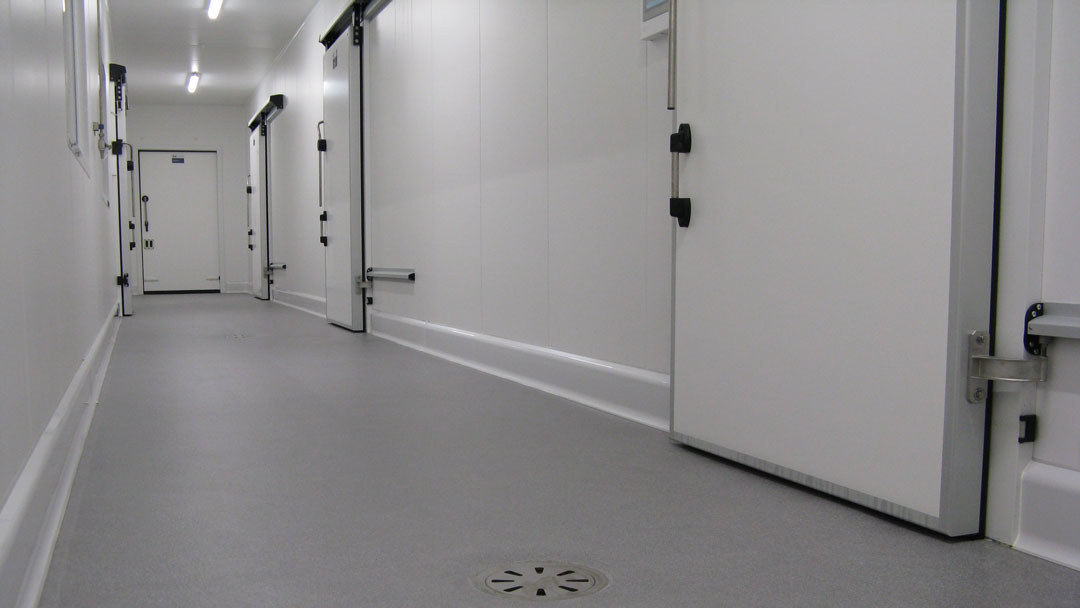


The rounded profile removes the square corner where dirt builds up, and the smooth, non-porous surface is easy to clean. With a cold storage cove base from the CoRound™ system, three things change on the job site. No sealant line required along the wall. Pre-formed corners, no silicone-filled field cuts. No resin or cement to cure. At the door, a PVC cove base also works as a thermal break.
By Panelmart · Updated: October 2026
Why Does a Walk-In Cooler Need a Rounded Wall-Floor Juncture?
Square corners can trap dirt and water, and that is where bacteria can grow. A rounded profile leaves fewer of those spots and makes them easier to wash out.
FDA Food Code §6-201.13 requires floor and wall junctures to be coved and closed to no larger than 1 mm (1/32 inch) where floors are not cleaned by water flushing, and coved and sealed where they are. Check requirements with your local health department.
If you are new to the topic, first read what a PVC sanitary cove base is.
How Does a Cold Storage Cove Base Work on Insulated Panels?
At the floor, the CoR Skirt sanitary base covers the wall-floor juncture. Flexible co-extruded lips press against the wall and the floor and follow small surface irregularities, closing the juncture. On standard cold storage panels with mesa or wide-rib profiles, the flexible lip follows the ribs.
Similarly, between walls and at the ceiling, the CoR 4 rigid PVC cove base snaps onto the CoR 4 Base. Flexible co-extruded lips press against both walls, or the wall and the ceiling, and follow small surface irregularities, closing the junction.
On ribbed panels, a metal base usually needs a bead of sealant along the wall: a second step, and exposed sealant can turn dark and attract dirt over time, leaving a dark line between a white wall and a white base. With CoRound, no sealant line is required along the wall.
In addition, with a metal base, each corner, column and door opening can mean a miter cut on site and silicone to close it, and the result depends on the installer’s hand. CoRound has pre-formed pieces for them: joints, 90° inside and outside corners, and end caps. Besides, metal bases and channels can rust where water sits. PVC does not rust.
What Happens at the Door When Warm Air Comes In?
PVC conducts far less heat than metal. At doors, where warm air comes in, a metal cove base acts as a thermal bridge: it carries the cold right to the edge of the opening, where condensation and ice tend to form. A PVC cove base works as a thermal break: much less condensation and ice at the door.
Then, at the door itself, an end cap closes each CoR Skirt run.
What Goes Under the Panels?
With a cold storage cove base, the panels also need a base track at the floor. The CoRound Channel is a U-shaped PVC base track that seats the base of the insulated panels in walk-in coolers and freezers and in food plants. It takes the place of a metal U-channel or angle.
PVC conducts far less heat than metal. Used instead of a metal channel on the edge of insulated panels, it works as a thermal break: less thermal bridging and a lower risk of condensation there.
The CoR Skirt snaps into the CoR Channel and is then fastened to the wall: base track and sanitary base are made to fit together. The channel seats the base of the insulated panels; tall panels still need to be braced until they are fastened.
Can a Walk-In Cooler Cove Base Go In While the Room Is in Operation?
In a room already in operation, CoRound can be installed on the finished floor: there is no floor to redo and nothing to cure.
That is why a walk-in cooler cove base also works for renovations. For a full upgrade, read our walk-in cooler renovation guide and our comparison with resin coving.
What Happens When Forklifts Operate in the Cold Storage Area?
The CoR Curb is a heavy-duty PVC curb for the base of the wall. Protects the wall from forklift impacts. It protects the wall, not people: it is not a safety barrier. Where forklifts operate, the CoR Curb takes the place of the sanitary base at the wall-floor juncture.
By comparison, a rigid curb, poured or precast, can chip or crack under a hard forklift hit. The CoR Curb is resilient PVC that flexes on impact. Pouring a concrete curb inside a cold storage room can mean a special cold-weather mix, or shutting the room down until the concrete cures. The CoR Curb needs no pouring and no curing, and the room can stay in use.
Why Choose a Cold Storage Cove Base From Panelmart?
- No sealant line required along the wall: one less step on site and, as a result, one less cost that can recur.
- Pre-formed corners, no silicone-filled field cuts: the curve comes from the factory, not from the installer’s hand.
- No resin or cement to cure: there is nothing to mix, trowel, weld or cure.
- Thermal break: a PVC cove base at the door and a PVC base track under the panels.
The CoRound system — stocked in the US by Panelmart. Available by the box or by the piece. Browse our sanitary PVC profiles, from the cove base for walk-in coolers to the corner guards.
Building the walk-in too? Panelmart also sells GlobeWall insulated panels, so the panels and the cove base come from one supplier. Read our guide to symmetrical insulated panels.
Frequently Asked Questions
Can I use CoRound as a freezer cove base?
Operating temperature: −4 °F to +140 °F. For colder applications, contact us. So, before you order a freezer cove base, check the room temperature with our technical team.
Do I need silicone along the wall of a walk-in cooler?
Silicone is optional: not required for installation. On standard cold storage panels with mesa or wide-rib profiles, the flexible lip follows the ribs.
Can I replace one damaged length of CoRound?
A damaged length can be replaced on its own: the rest of the run stays in place.
How Do I Get a Quote, Specs or Free Samples?
Call or message us at +1 786 917 8106 (phone and WhatsApp), or email [email protected]. Our technical team usually responds within one business day. Contact Panelmart today for a quote, specs or free samples.