

By The Panelmart Engineering Team | Fact-Checked & Updated: April 2026
What Does cGMP Require For Floor-to-Wall Junctures in Pharmaceutical Manufacturing Facilities?
When an FDA inspector audits a pharmaceutical plant, a medical device manufacturing facility, or a food processing center, they evaluate the building against the highest standard of safety: Current Good Manufacturing Practice (cGMP). In these environments, the architecture itself must actively prevent cross-contamination.
One of the most frequently cited violations during an FDA audit is improper cleanroom wall transitions. When the juncture where your wall meets the floor uses materials that degrade over time, you risk product recalls and facility shutdowns. Therefore, let’s break down exactly what the FDA demands from your perimeter and why a rigid PVC cove base delivers the ultimate solution. For a complete overview, start with our guide on what a PVC sanitary cove base is.
What Are the FDA cGMP Facility Requirements for Floors and Walls?
According to the official FDA cGMP regulations, facility design must facilitate rigorous cleaning, maintenance, and proper operations. Specifically, the geometry of the room plays a critical role in this mandate.
To meet FDA cGMP facility requirements, the juncture between the floor and the wall cannot form a sharp 90-degree angle. Sharp corners are impossible to fully sanitize. In fact, they act as collection points for dust, chemical residues, and microbial growth. Instead, the intersection must feature a cGMP compliant radius profile — a smooth, continuous concave curve that allows cleaning agents and sanitizing tools to sweep the area effortlessly. This requirement mirrors FDA Food Code 6-201.13, which enforces the same geometric standard across food facilities. For state-level enforcement, see our guide on the 3/8-inch radius cove base rule for CalCode and FRP walls.
Why Do Epoxy and Rubber Fail cGMP Standards?
Many contractors attempt to create this required radius using hand-troweled epoxy or flexible rubber rolls. However, both of these traditional materials introduce severe risks to a cGMP environment:
- Epoxy fractures and particulates: Troweled epoxy creates a rigid, monolithic bond between the floor and the wall. When the building experiences natural structural settlement or vibrations from heavy equipment, the epoxy cannot flex. As a result, it fractures, breaks the sanitary seal, and releases microscopic particulates into the sterile air. For a full comparison, see our guide on epoxy cove base curing time vs. PVC.
- Chemical outgassing: Rubber and vinyl baseboards rely on heavy construction adhesives. In a highly controlled environment, these glues outgas Volatile Organic Compounds (VOCs) for months. Consequently, they contaminate the ambient air and compromise sensitive manufacturing processes. See our comparison of rigid PVC vs. rubber cove base for the full breakdown.
How a Rigid PVC Cove Base Guarantees a cGMP Compliant Radius Profile
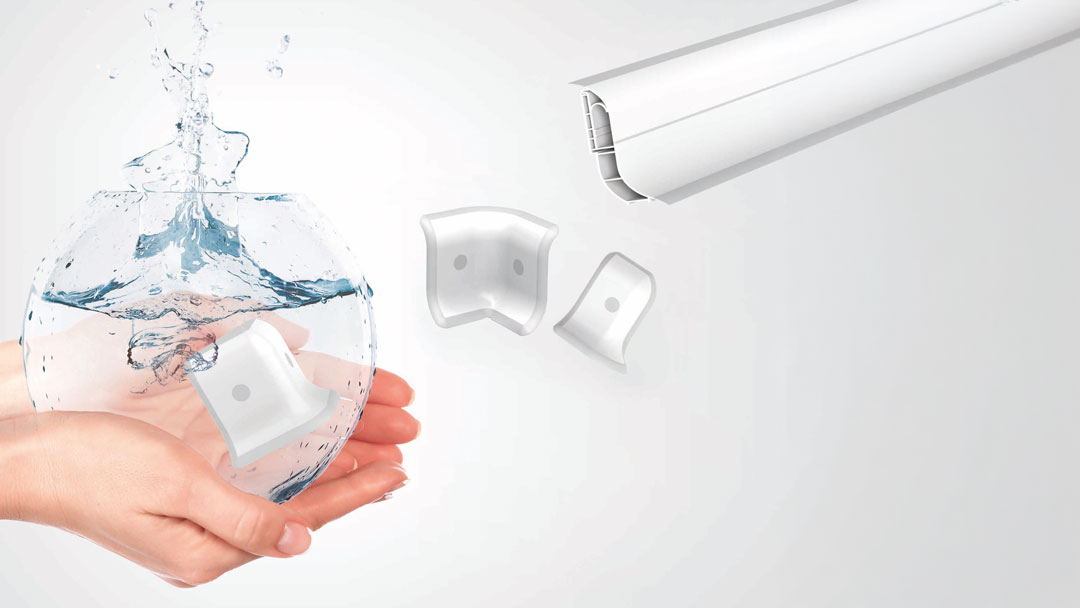
To pass a rigorous FDA audit, your facility needs an architectural trim that relies on precise engineering rather than inconsistent troweling or melting glues. Panelmart distributes the CoRound system nationwide and ships directly to your job site. Together, these features deliver the ultimate pharmaceutical sanitary base.
Our rigid PVC cove base physically eliminates the weak points of cleanroom construction:
- A mathematically perfect curve: Globe Panels engineers the CoRound profile as a 4-inch wide cove base that exceeds the FDA Food Code 3/8″ minimum radius requirement. As a result, your facility achieves a flawless cGMP compliant radius profile without relying on any on-site measurement or guesswork.
- Mechanical decoupling: Installers screw the PVC track directly into the wall structure, which entirely eliminates VOC-emitting glues. Furthermore, because the system bonds to the wall only — not the floor — the building settles independently without cracking the profile or generating particulates.
- Silicone-free hermetic seal: Traditional trims require silicone caulking, which degrades under harsh chemical sterilants like Vaporized Hydrogen Peroxide (VHP). In contrast, the CoRound system uses co-extruded flexible rubberized lips. These lips compress against the wall and floor and deliver an instant, permanent, and easily cleanable seal — with no silicone required.
For pharmaceutical and food processing environments that the USDA regulates, see our dedicated USDA compliant cove base guide. Additionally, for cleanroom-specific applications, see our cleanroom cove base system overview.
Secure Your Next FDA Audit
Do not let a cracked epoxy joint or a peeling rubber baseboard trigger a cGMP violation. Instead, upgrade your facility with an impact-resistant, mechanically fastened perimeter that Panelmart engineers for strict compliance. Contact Panelmart today to specify a rigid PVC cove base for your next critical build-out.