

By The Panelmart Engineering Team | Fact-Checked & Updated: April 2026
What Are The Cove Base Requirements Under California Retail Food Code Section 114268?
Operating a food facility in California means meeting some of the strictest CalCode cove base requirements in the United States. When a local health inspector walks into your facility with a radius gauge, they are not just looking for cleanliness — they are measuring specific geometric curves. If your FRP wall panels are finished with a flat or collapsing baseboard, you face an immediate code violation.
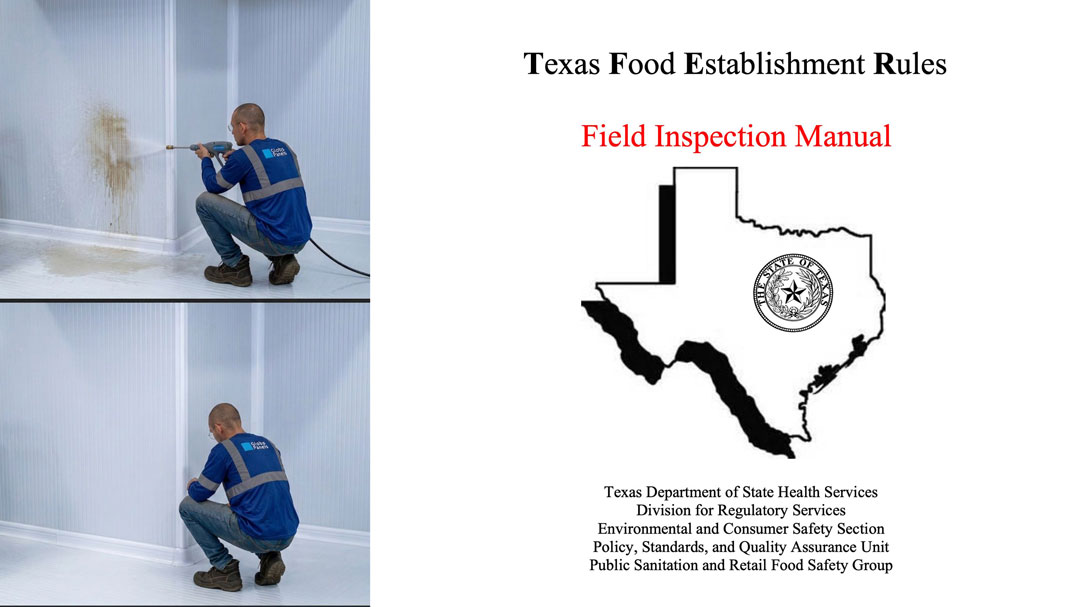
Furthermore, this rule does not stop at the California border. The federal FDA equivalent applies in all 50 states. In Texas, the same standard appears in the TFER cove base requirements. In Florida, see the Florida DBPR plan review guide.
What Do CalCode Cove Base Requirements Actually Specify?
The California Retail Food Code (CalCode) Section 114268 is explicit about how contractors must build floor-to-wall junctures. In areas where workers prepare or store food, or where they wash utensils, the floor must be coved at the juncture with the wall. Specifically, the code requires a minimum 3/8-inch radius curve that extends at least 4 inches up the wall.
This curve eliminates the sharp 90-degree corner that naturally traps grease, moisture, and bacteria like Salmonella. As a result, mops and squeegees can reach the entire surface in a single pass. The inspector’s term for this is an “easily cleanable” surface — and it is the standard every food facility in California must meet before receiving a certificate of occupancy.
Why Do Standard Baseboards Fail CalCode Cove Base Requirements?
Many contractors attempt to meet CalCode cove base requirements with flexible rubber or vinyl baseboards. These materials are inexpensive. However, they create two major failure points during a California health inspection:
- Collapsing geometry: Rubber is soft. When a contractor presses it into a corner, it does not hold a perfect mathematical curve. Consequently, if an inspector’s radius gauge finds any section under 3/8 of an inch, the facility fails immediately. See our detailed comparison of rigid PVC vs. rubber cove base for the full breakdown.
- Peeling adhesives: California food facilities undergo intensive cleaning cycles. Standard hot water washdowns and degreasers quickly soften the glues behind rubber baseboards. Once the baseboard peels, the sealed juncture breaks down and bacteria grow behind the FRP wall panels. In addition, this triggers costly maintenance callbacks that erase the original labor savings. See our guide on epoxy cove base curing time vs. PVC to understand the full cost implications.
How Does a Rigid PVC Sanitary Cove Base Guarantee CalCode Compliance?
To pass a CalCode inspection on the first attempt, you need a material that installers simply cannot apply incorrectly. That is precisely why Globe Panels engineered the CoRound rigid PVC sanitary cove base system, distributed nationwide by Panelmart. It addresses every point of Section 114268 through three features.
The precision advantage. Globe Panels precision-extrudes CoRound profiles with a sweeping curve that exceeds the mandated 3/8-inch minimum radius requirement. Therefore, your facility has a built-in safety margin that no inspector’s gauge can challenge.
Mechanical fastening. Installers screw CoRound PVC profiles directly into the wall. The profile never peels, shifts, or loses its shape — even after years of standard hot water washdowns. In other words, the geometric compliance that installers achieve on day one is the same compliance the inspector finds five years later. For more detail, see our guide on easily cleanable floor-wall junctures.
Seamless pre-formed corners. Hand-cutting corners with a chop saw creates gaps larger than the 1mm legal maximum. Instead, Panelmart supplies the CoRound system with injection-molded, pre-formed internal and external corners that installers snap into place. The result is a perfect sweeping curve at every 90-degree room corner, with zero silicone required. Furthermore, this approach significantly reduces installation labor. See our guide on pre-formed sanitary corners and labor savings for full details.
For a complete overview of available profiles, see our PVC sanitary cove base guide. The same CoRound system is also available for cold storage and walk-in cooler environments. For California meat and poultry processing plants, see our dedicated USDA cove base guide.
Do CalCode Requirements Apply Outside California?
Yes. CalCode Section 114268 mirrors the federal FDA Food Code standard that all 50 states enforce. As a result, a CoRound installation that satisfies a California inspector will equally pass in Texas, Florida, Illinois, or any other state. In summary, you build once to the highest standard and achieve compliance everywhere.
Ready to Guarantee Compliance on Your Next Project?
Do not let a small geometric detail delay your facility’s opening or trigger a reinspection fee. Globe Panels engineered the CoRound rigid PVC sanitary cove base to exceed CalCode cove base requirements on every profile, in every installation. Panelmart stocks the complete system and ships directly to your project site anywhere in the United States.
Contact Our Team Today For Specifications And a Quote
📞 +1 786 917 8106 |
✉️ [email protected]
Contact Panelmart today to pass your next health inspection on the first try.